5 Secrets of Pollepel Island: What Most Hudson Valley Visitors Never Know
June 26, 2026
Most people see Bannerman Castle from a train window. A blur of stone turrets between Beacon and Cold Spring, gone before you can fully register what you just saw.
You’re going to ride right up to it.
But before you do — here are the four facts about Pollepel Island that will completely change how you look at those ruins.
1. He Was the Amazon of War
Forget medieval knights. Francis Bannerman VI wasn’t a nobleman — he was a Gilded Age arms dealer who became the single largest buyer of military surplus in America.
After the Spanish-American War ended in 1898, the U.S. government needed to liquidate its inventory fast. Bannerman bought it. All of it. 30 million cartridges. 125,000 rifles. Thousands of cannons.
He was so heavily armed that he was essentially a private military power. The city of New York refused to let him store that much gunpowder inside city limits — so he bought an island in the middle of the Hudson River and moved his entire operation there.
One man. One island. Enough firepower to outfit a revolution.
2. The Castle Was a Billboard
Here’s the part that blows everyone’s mind: the fortress wasn’t built to live in.
It was a marketing stunt.
Bannerman designed the buildings himself in the baronial style of his Scottish homeland — not because he wanted a home, but because he wanted every single person riding the steamships up the Hudson to see it. He had “BANNERMAN’S ISLAND ARSENAL” cast directly into the stone facade in giant letters.
A 20th-century billboard. Built from stone. Visible for miles.
He was doing in 1901 what brands spend millions trying to do today — make something so visually striking that people can’t look away. It worked. You’re still talking about it 125 years later.
3. There Are Thousands of Weapons Buried Under Those Rocks Right Now
When the buildings burned and the roofs collapsed, a massive portion of Bannerman’s inventory didn’t disappear — it got swallowed by the island.
Shells. Rifles. Gear. Military hardware from wars you studied in school — buried under the dirt and rubble of Pollepel Island, still there today. Hikers and caretakers have been finding pieces for decades.
When you ride up close and look at that shoreline, you’re not just looking at old stones. You’re looking at one of the most densely buried collections of American military history in the Northeast — and most of it has never been catalogued.
4. The Explosion That Scarred the Skyline Forever
In August 1920, a stockpile of powder detonated inside one of the storage rooms.
It wasn’t a fire. It was a detonation. Two hundred pounds of powder going off at once. The blast was heard for miles. It shook houses in Cornwall and Cold Spring. Sections of wall were blown clear across the river.
The ruin aesthetic you see today — the collapsed towers, the missing walls, the dramatic silhouette against the Highlands — that’s not just time and decay. That’s the physical scar of a Gilded Age explosion that permanently changed the skyline of the Hudson River forever.
Then vs. Now
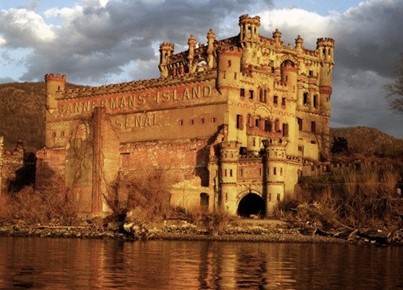
From Gilded Age Armory to today’s Hudson Highway. You aren’t just riding a jet ski — you’re riding through history.
The Ride
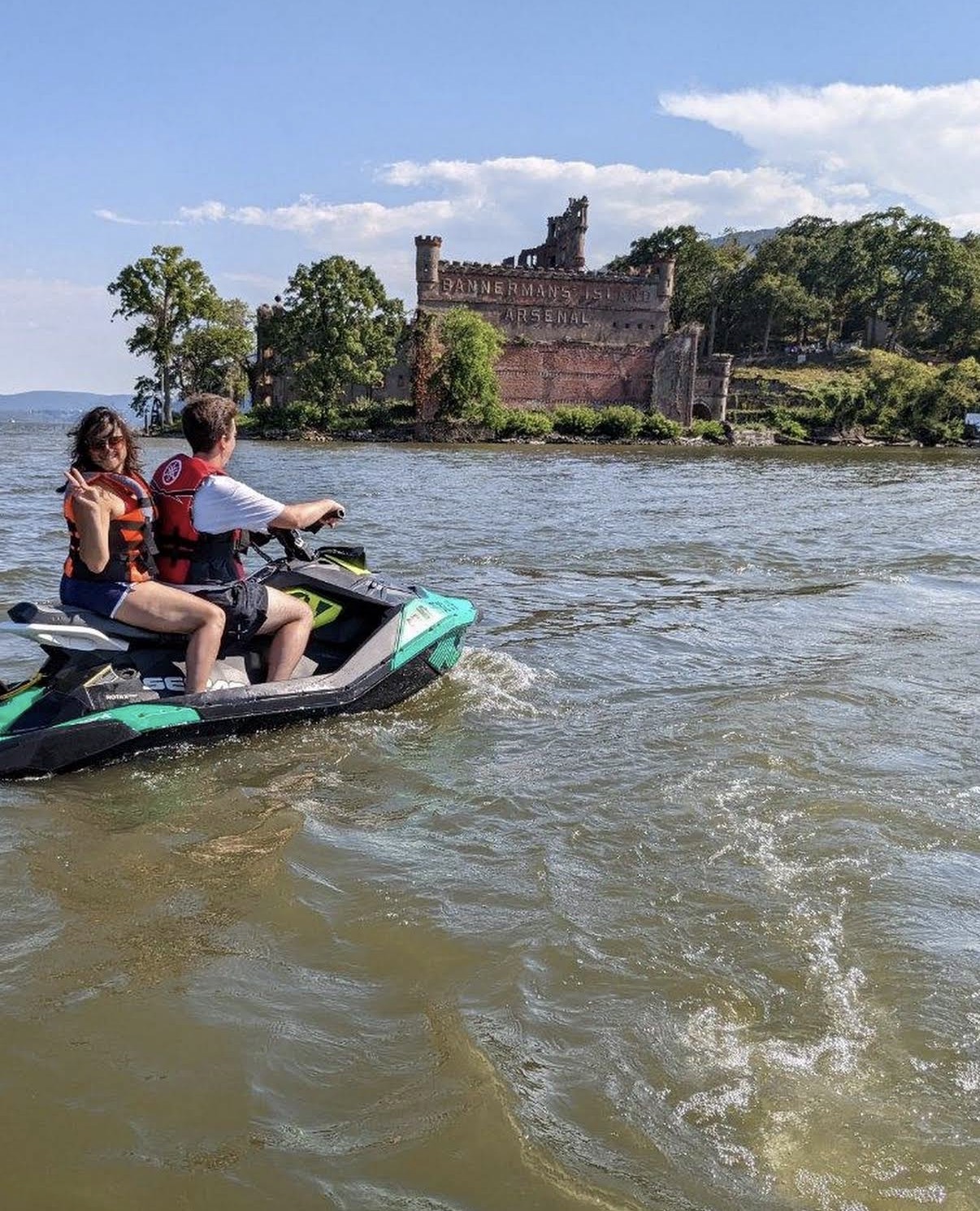
From our launch in Cornwall-on-Hudson, you track south through the Highlands with Storm King Mountain at your back. The river narrows. Then the island appears — and your guide brings the group in close so you can take in the arsenal wall, the stone letters still visible in the facade, and the ruins rising above the treeline.
You view everything from the water. The island is managed by the Bannerman Castle Trust, and the structures are genuinely unstable. But from the water — the angle you see in the photo above — it’s the most dramatic view on the Hudson.
No boating license required. Every expedition is led by a certified river guide start to finish.
You aren’t just riding a jet ski. You’re riding through history.
Frequently Asked Questions
- Do I need a boating license to ride to Bannerman Castle?
- No. Because every expedition is led by one of our certified river guides who stays with your group the entire ride, you do not need your own New York Boating Safety Certificate to join. Riders must be at least 18 to operate a ski; younger guests can ride as passengers.
- Can I land on Bannerman Castle / Pollepel Island on the jet ski?
- No. The island is managed by the Bannerman Castle Trust and you can only set foot on it through their official guided walking and kayak tours. Our expedition rides to the island and views the ruins from the water — which is the most dramatic angle there is.
- When can I book a Bannerman expedition?
- We run guided rides on weekends from roughly June through September, weather permitting. The Hudson Highlands are at their best on clear summer mornings.
- Where do the tours leave from?
- From our launch in Cornwall-on-Hudson, NY, in the shadow of Storm King Mountain — one of the closest launch points to the island on the river.